F100 Restomod · Guide Library · Fridge
1957–1960 Ford F-100 — Fridge
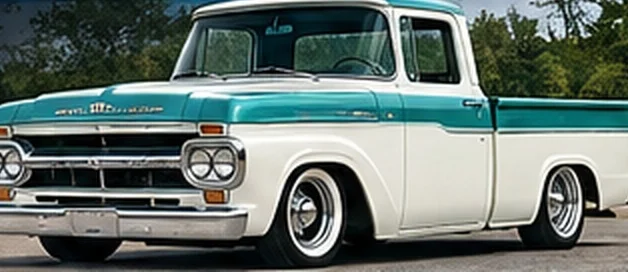
Fits · 1957–1960 only — this IS the generation guideThe Fridge brought the wide Styleside body and, for 1959, Ford’s first factory 4×4 pickup. The street-truck build stays traditional — dropped axle or a purpose-built IFS — and this guide covers both, plus engines (including the 1958–60 352 FE), budget, and parts.
Generation Notes
Build philosophy: Prioritize stance, steering, brakes, and wheel fitment. Keep the original frame and running engine where practical; expensive swaps should be a deliberate choice, not the first step.
The 1957–1960 F-100 has its own body and chassis details. A lowered street build can stay traditional with a dropped front axle, or use a purpose-built independent front suspension conversion. Check whether the truck is 2WD or 4WD before ordering parts.
The generation introduced the wider Styleside body; factory four-wheel drive became available for 1959. Front suspension and steering parts must match the actual configuration. On engines: the 292 Y-block was the 1957 V8 and continued as a smaller option, while for 1958–60 the optional V8 was the 352 FE — a ’59 owner with a factory 352 fits neither the “six” nor the “Y-block” label.
Best DIY Modifications
Front dropped axle or IFS conversion
Planning cost: $700–$1,800+ for a dropped axle route; roughly $1,500–$3,500+ for an IFS conversion before major labor.
A dropped axle preserves the vintage feel. An aftermarket Mustang II-style IFS can improve packaging and steering, but needs a kit specifically suitable for the frame and professional welding/geometry checks.
Rear lowering
Planning cost: $150–$600 for basic parts; more for custom fabrication.
Consider matched lowering springs, blocks, or a designed rear setup. Check frame clearance, bump travel, pinion angle, shock travel, and brake hoses.
Steering, brakes, and wheel bearings
Planning cost: $300–$1,200+ depending on condition and upgrades.
Restore worn original components first. If changing front suspension, plan steering column linkage, master cylinder, brake balance, and wheel clearance as one system.
Rear axle upgrade
Planning cost: $300–$1,200 used parts; more rebuilt.
Ford 9-inch and later Ford axle options may be candidates, but compare width, spring perch spacing, gearing, brakes, and wheel bolt pattern before buying.
Engine Swap Options
| Engine / route | Approx. DIY parts cost | Pros & compatibility notes |
|---|---|---|
| Keep / refresh the original — six, Y-block, or (1958–60) 352 FE V8 | $500–$2,500 for used engine/refresh parts | Often the lowest-cost route if the engine is healthy. Verify which engine is actually in the truck. |
| Ford 302 Windsor | $1,000–$3,500 for used engine and basic conversion parts | Common street-truck swap candidate; requires appropriate mounts, oil-pan clearance, cooling, exhaust, transmission, and driveshaft planning. |
| Ford 351 Windsor | $1,500–$4,000 for engine and basic parts | Adds displacement and torque potential; verify all fitment and driveline details. |
| Coyote 5.0 | $10,000–$18,000+ for a DIY parts build | Modern power but high total cost for electronics, fuel delivery, transmission, cooling, exhaust, and fabrication. |
Engine cost ranges are broad planning estimates, not installed quotes. They exclude many labor, shipping, tax, and troubleshooting costs. Identify the engine and transmission actually in the truck before purchasing swap parts.
Example Budget
| Item | Planning budget |
|---|---|
| Front drop axle / IFS allowance | $700–$2,000 |
| Rear lowering and shocks | $250–$700 |
| Steering/brake refresh allowance | $400–$1,000 |
| Wheels and tires | $600–$1,400 |
| Alignment, fluids, hardware | $200–$500 |
| Planning total (not a quote) | $2,150–$5,600+ |
Budget assumptions. Assumes a usable frame, a running engine/transmission, mostly DIY labor, and no major rust or structural repair. The total is an initial planning range — not a guaranteed all-in cost. A complete brake conversion, custom fabrication, frame notch, or professional welding can increase the price.
Build Order
Recommended build sequence
- 1 · Identify the truck. Confirm model year, 2WD/4WD, wheelbase/bed, engine, transmission, axle, and any prior modifications.
- 2 · Inspect before buying. Check frame rust, steering mounts, suspension pivots, brakes, wheel bearings, fuel lines, and driveline condition.
- 3 · Choose the target stance. Decide mild versus aggressive drop, and plan front/rear heights together.
- 4 · Select compatible suspension parts. Use year-specific fitment and verify travel, geometry, bump stops, brake hoses, and driveshaft angles.
- 5 · Confirm wheel fitment. Check bolt pattern, width, offset/backspacing, brake clearance, and tire clearance at full steering lock and suspension travel.
- 6 · Align and test safely. Verify steering, braking, suspension travel, and driveline behavior before daily use.
Recommended starting build
For a budget cruiser, retain the original frame and choose a complete, engineered front suspension path. A 1959–1960 4WD truck needs a different plan from a 2WD street truck; do not use 2WD lowering assumptions on a 4WD.
Use rated jack stands; never work under a truck supported only by a jack. Structural welding and critical suspension mounts should be completed or inspected by a qualified fabricator. Brake and steering modifications must be properly engineered and tested before road use.
Parts list — shop this generation’s build
Built from this guide’s own sections. Links are marked affiliate slots until each retailer program approves F100 Restomod — hard parts route to CJ Creators / JEGS, tools and consumables to Amazon, donor and used parts to eBay Partner Network. Fat Fender Garage and QA1 run no affiliate programs, so they appear as name-only mentions.
- Dropped front axle, 1957–60 — JEGS · CJ CreatorsAffiliate slot
- Mustang II-style IFS conversion kit — frame-specific — JEGS · CJ CreatorsAffiliate slot
- Kingpin set & tie rods (steering refresh) — JEGSAffiliate slot
- Rear lowering blocks / lowering springs — JEGS · CJ CreatorsAffiliate slot
- Front disc brake conversion kit — JEGS · CJ CreatorsAffiliate slot
- Used Ford 9-inch rear axle (donor) — eBay Partner NetworkAffiliate slot
- Drop shocks, front & rear — JEGS · CJ CreatorsAffiliate slot
Reference Notes
Use these references for generation history and specific installation context. Parts compatibility and prices must be confirmed with the manufacturer/supplier for the exact truck. Some linked guides are historical and should be treated as starting points, not substitutes for current installation instructions.
- F-100 generation history and Twin I-Beam timing: supermotors.net/registry/ford/f-100
- 1961–1966 chassis, unibody, and engine overview: supermotors.net/registry/ford/f-100/1961-1966
- 1953–1956 Mustang II crossmember instructions: static.speedwaymotors.com/pdf/910-34425.pdf
- 1953–1956 rear axle/lowering discussion: ford-trucks.com — 1953–1956 F100 rear end selection
- 1965–1979 IFS / Twin I-Beam overview: Classic Truck Performance, July 2024
All dollar figures are rough U.S. planning estimates and can vary substantially with donor condition, parts availability, fabrication, shipping, and the amount of work done at home.